
FDE ROLE AND CAREER
What Does a Forward Deployed Engineer Do Each Day?
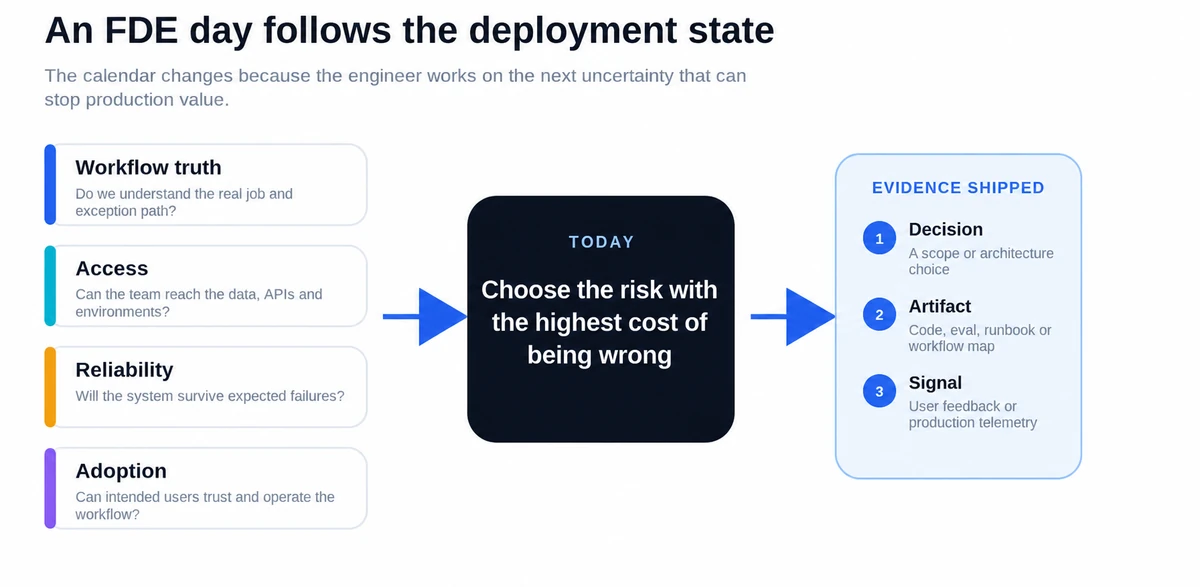
The useful way to understand an FDE’s routine is to follow the deployment state. Discovery days remove workflow uncertainty. Build days remove technical uncertainty. Rollout days remove production and adoption risk.
Direct answer
A forward deployed engineer spends each day removing the next risk that can stop a customer deployment. Early in an engagement, that may mean shadowing users, mapping a workflow and testing access. During build, it may mean writing full-stack code or creating evaluations. During rollout, the same engineer may inspect traces, repair a failure path, support first users and decide whether to continue or roll back. The routine changes. The ownership thread does not.
Why is there no standard FDE day?
A standard calendar assumes that the work arrives in a stable form. Forward deployed work does not. The engineer may start with a business outcome, partial access and several versions of how the process supposedly works. The immediate task is to find which uncertainty is expensive enough to block the next decision.
Current role descriptions support this phase-based view. OpenAI’s healthcare FDE role [1] spans discovery, architecture, implementation, evaluation, production deployment, adoption and handoff. OpenAI’s UAE FDE role [2] describes ownership of the delivery state from first prototype to stable production. OpenAI’s forward deployed software engineer role [3] adds detailed scoping and an experiment-driven build approach.
The same pattern appears outside OpenAI. Palantir’s FDSE description [5] places engineers side by side with customers to understand difficult problems and build the solution. Anthropic’s FDE description [6] includes production applications inside customer systems, deployment support and reusable field patterns. These are not separate jobs stitched together. They are different states of one delivery problem.
The calendar follows the bottleneck
If the unknown is the workflow, the FDE observes and maps. If the unknown is an API, the FDE writes a thin integration. If the unknown is quality, the FDE creates cases and thresholds. If the unknown is launch safety, the FDE instruments the system and rehearses recovery.
This is why a job description can truthfully include customer conversations, code, evaluation, deployment and documentation without implying that every day contains equal parts of each. For a deeper explanation of the ownership boundary, read what a forward deployed engineer is.
| Phase | Question driving the calendar | Dominant work | Evidence that moves the engagement |
|---|---|---|---|
| Discovery | What is the real workflow and where does it fail? | Operator shadowing, workflow mapping, access checks | Workflow map, risk list, agreed outcome |
| Prototype | Can the riskiest path work under real constraints? | Full-stack spike, integration, rapid tests | Thin vertical slice and technical decision |
| Rollout | Can intended users complete the workflow safely? | Deployment, onboarding, monitoring, triage | Launch signals and controlled failure behaviour |
| Stabilisation | What breaks under real load or edge cases? | Error analysis, eval expansion, reliability work | Lower failure rate and faster recovery |
| Handoff | Can another team operate and improve the system? | Runbooks, training, ownership transfer, pattern capture | Support readiness and reusable field learning |
How does an FDE use time across different phases?
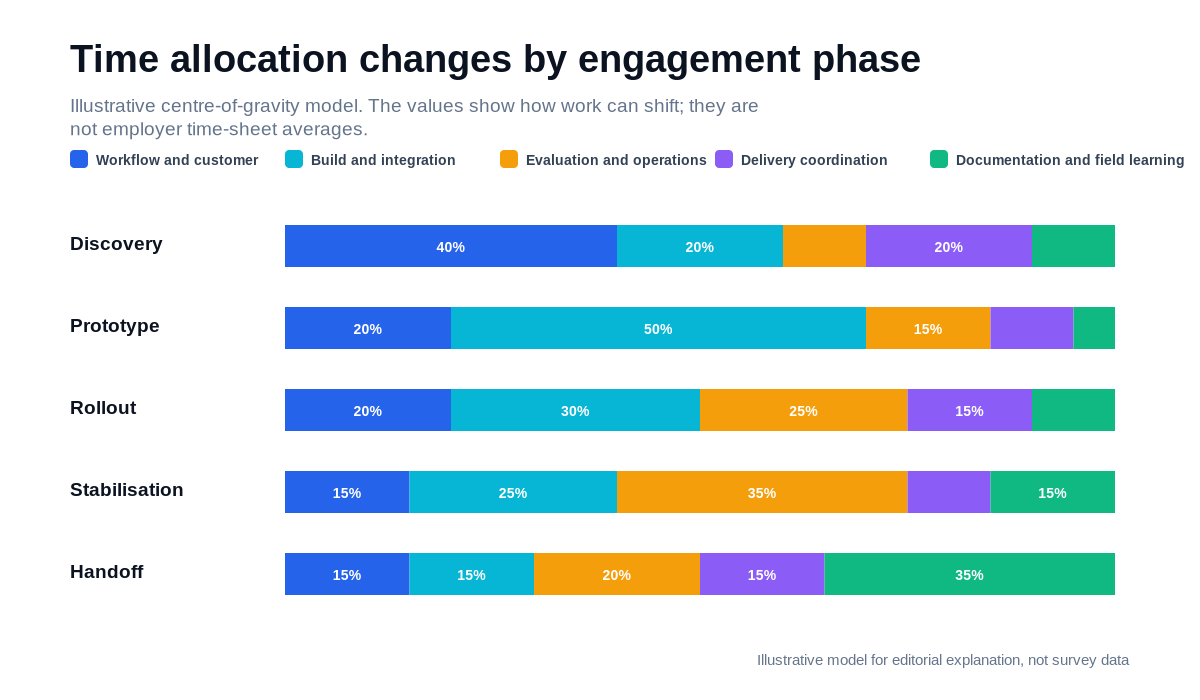
There is no defensible universal percentage for coding, meetings or travel. A better model is to estimate the centre of gravity for each phase. The chart below is an editorial model built from the work categories in current FDE descriptions. It is designed to explain the shift in work, not to report employer time-sheet data.
Explore one phase
Replace assumptions about the workflow, access and success criteria with evidence.
| Phase | Workflow and customer | Build and integration | Evaluation and operations | Delivery coordination | Documentation and learning |
|---|---|---|---|---|---|
| Discovery | 40% | 20% | 10% | 20% | 10% |
| Prototype | 20% | 50% | 15% | 10% | 5% |
| Rollout | 20% | 30% | 25% | 15% | 10% |
| Stabilisation | 15% | 25% | 35% | 10% | 15% |
| Handoff | 15% | 15% | 20% | 15% | 35% |
The percentages are an illustrative model. They should not be presented as survey findings or employer benchmarks.
What does a technical discovery day look like?
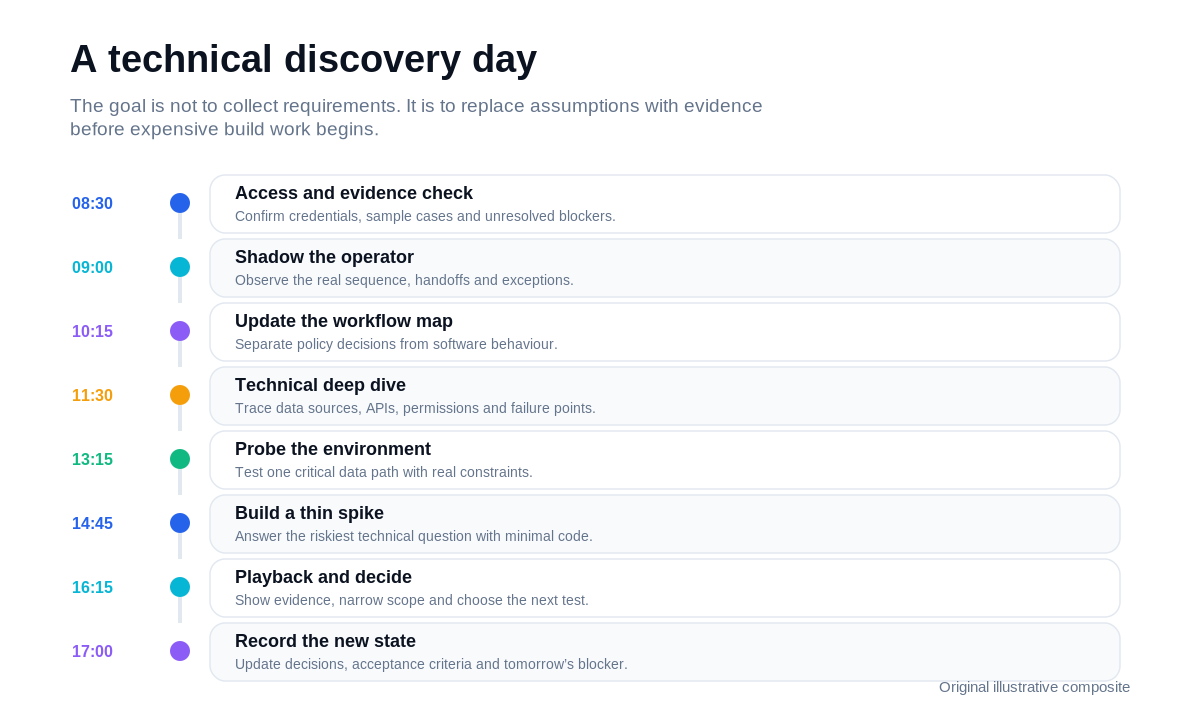
Technical discovery is often misunderstood as a sequence of requirement meetings. That framing is too passive. The FDE is trying to discover the smallest set of truths needed to make a safe build decision.
The day usually starts with evidence, not a presentation. The engineer checks whether the team has representative cases, working credentials and access to the environment where the workflow will run. A missing permission can make a polished architecture discussion irrelevant.
Next comes direct observation. OpenAI’s workflow-mapping guidance [7] argues for understanding multi-step work rather than isolated AI tasks. For an FDE, that means watching how an operator handles normal cases and exceptions. The stated process may say “review and approve.” The actual process may include an undocumented spreadsheet, a call to a specialist and a manual correction before approval. That hidden path changes the system design.
A meeting should change an artifact
A discovery session earns its place on the calendar when it changes the workflow map, scope, decision record or test plan. If the same meeting can recur without changing any of these, the engagement is collecting conversation rather than reducing uncertainty.
What does a production rollout day look like?
A rollout day is less predictable because customer behaviour and system behaviour become visible at the same time. The FDE has to protect two things: the launch criteria and the ability to recover.
The day begins with production signals. OpenTelemetry’s observability guidance [10] describes traces, metrics and logs as the signals needed to ask why a system behaves as it does. Google SRE’s monitoring guidance [11] recommends low-noise alerting and focuses user-facing monitoring on latency, traffic, errors and saturation. For an AI workflow, those signals need workflow context. A request can return HTTP 200 and still produce the wrong action.
Model behaviour also needs its own evidence loop. OpenAI’s agent-evaluation guide [9] recommends using traces to identify workflow-level failures, then moving to repeatable datasets and eval runs. OpenAI’s evaluation best practices [8] adds continuous evaluation as the system changes. This is why a rollout day includes both production debugging and eval maintenance.
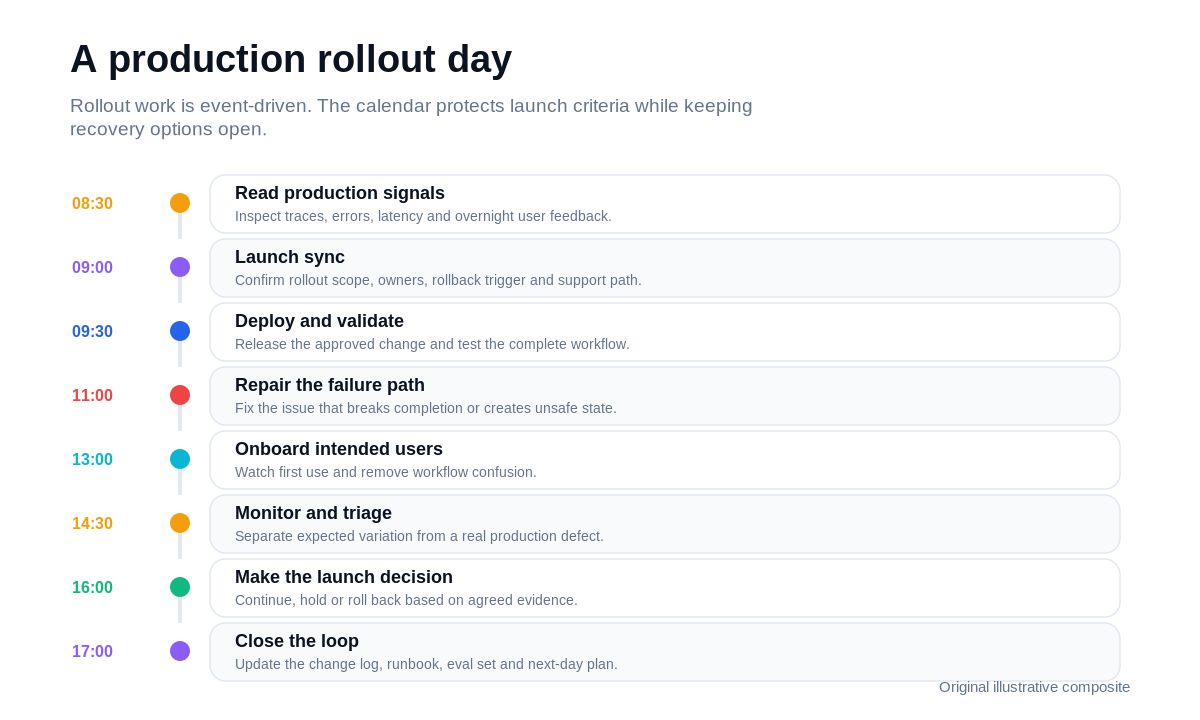
Recovery deserves explicit calendar time. AWS guidance on rollback safety [13] explains why deployments can become hard to reverse when code and data states diverge. AWS guidance on retries and backoff [12] shows how a seemingly small dependency failure can amplify load. An FDE who ignores these control paths may ship a fast demo and create a fragile production system.
The rollout calendar is a control system
Launch syncs, telemetry reviews and decision checkpoints are not administrative rituals. They are feedback points that keep the deployment inside an agreed risk boundary.
How much of an FDE’s day is spent coding?
No credible public source supports one universal percentage. The coding share depends on what is blocking progress and how the employer divides work between FDEs, forward deployed software engineers and deployment leads.
The better question is: Is code the fastest safe route to the evidence we need? If the team does not agree on the workflow, more code creates rework. If the critical uncertainty is whether a legacy API can support the required action, a thin integration may be more useful than another meeting.
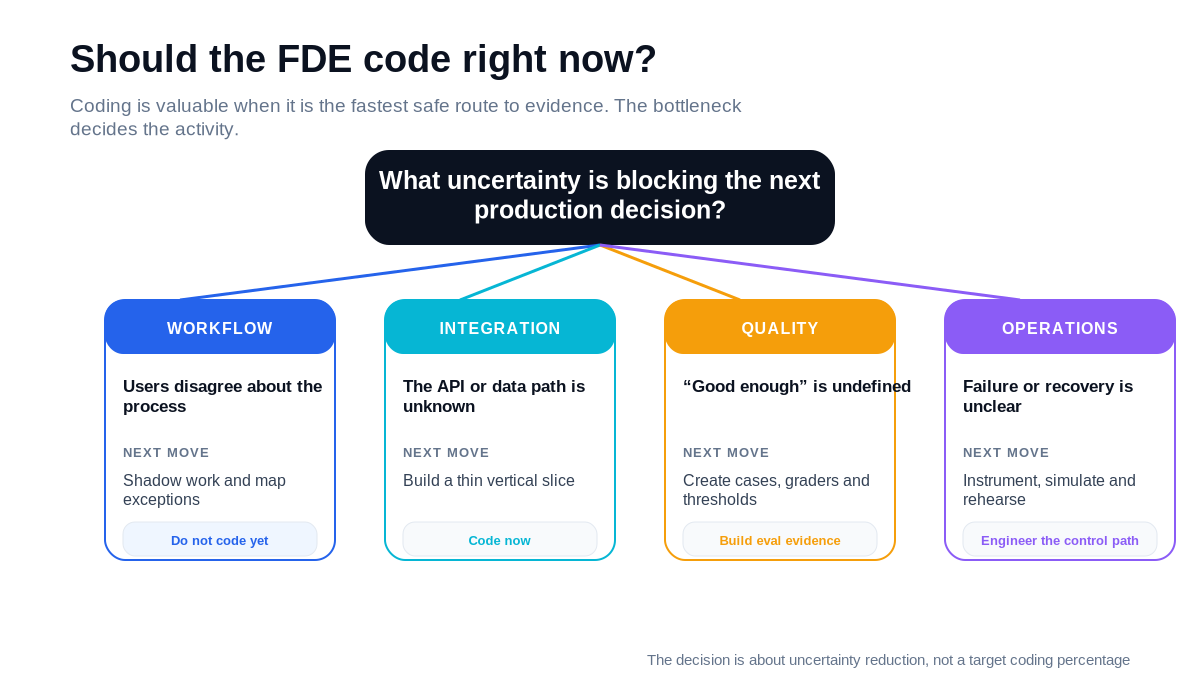
OpenAI’s FDSWE description [3] explicitly uses an experiment-driven, iterative approach to full-stack solutions. OpenAI’s UAE FDE role [2] frames the broader job as scoping, sequencing and building while owning the delivery state. The practical distinction is useful: the FDE does not optimise for maximum coding time. The FDE optimises for the fastest reliable movement toward production value.
A coding hour can serve four different purposes
| Purpose | Example | Stop condition |
|---|---|---|
| Feasibility | Probe whether the source system can expose the required field. | The technical constraint is known. |
| Integration | Connect one end-to-end path across model, API and customer system. | The workflow completes with real interfaces. |
| Reliability | Add state, idempotency, timeout handling or recovery logic. | The expected failure path is controlled. |
| Scale | Turn a one-off pattern into a reusable component. | Another deployment can adopt it with less custom work. |
What does an FDE produce during a normal week?
The most reliable way to judge a week is to inspect the artifact trail. A calendar can look busy while the delivery state remains unchanged. Artifacts make the new state visible to someone who was not in the room.
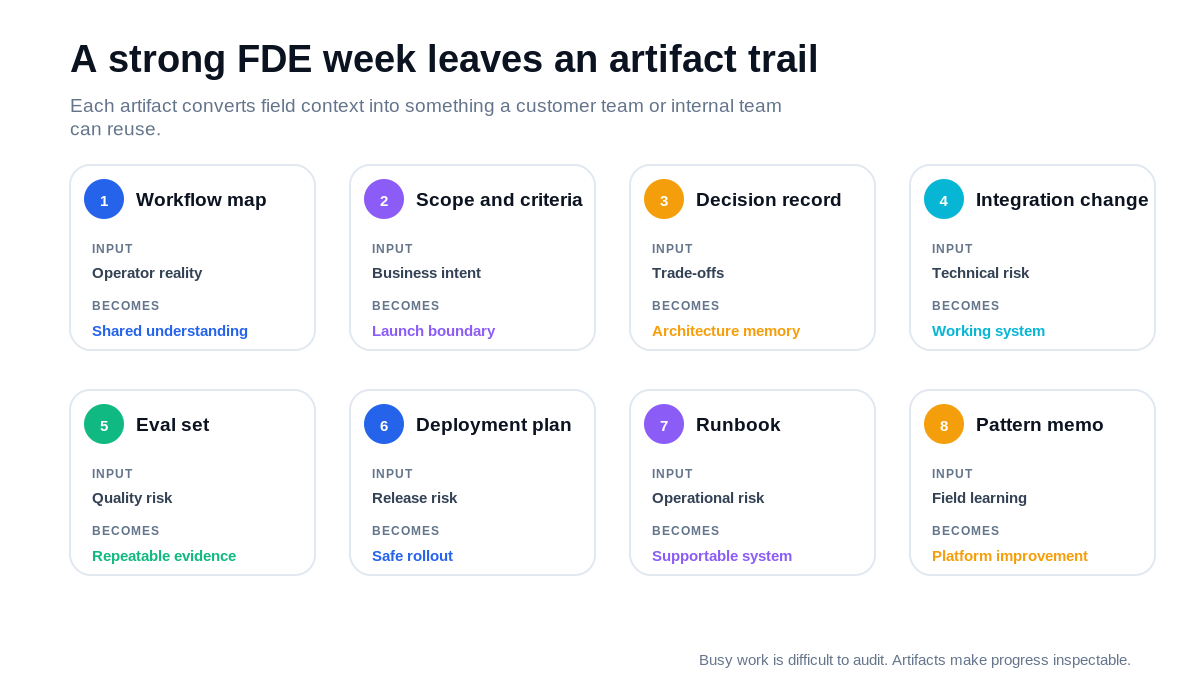
| Artifact | Question it answers | Who can use it |
|---|---|---|
| Workflow map | What actually happens, including exceptions? | Customer operators and the build team |
| Scope and acceptance criteria | What will the first release prove? | Customer owner and delivery team |
| Architecture decision record | Why was this technical trade-off chosen? | Engineers and future maintainers |
| Integration change | Can the workflow operate across real systems? | Customer engineering and platform teams |
| Eval dataset and report | Is quality measurable and repeatable? | Product, engineering and domain reviewers |
| Deployment and rollback plan | How can the team release without losing control? | Operations and incident owners |
| Runbook and ownership map | Who responds after handoff? | Support and customer teams |
| Field-pattern memo | What should become reusable? | Product and platform teams |
OpenAI’s healthcare role [1] explicitly includes reusable architectures, integration patterns and evaluation harnesses. Anthropic’s role [6] similarly asks FDEs to codify deployment patterns and return insight to product teams. This second output matters. A deployment that works once creates customer value. A pattern that reduces the cost of the next deployment creates platform leverage.
How do travel and customer proximity change the routine?
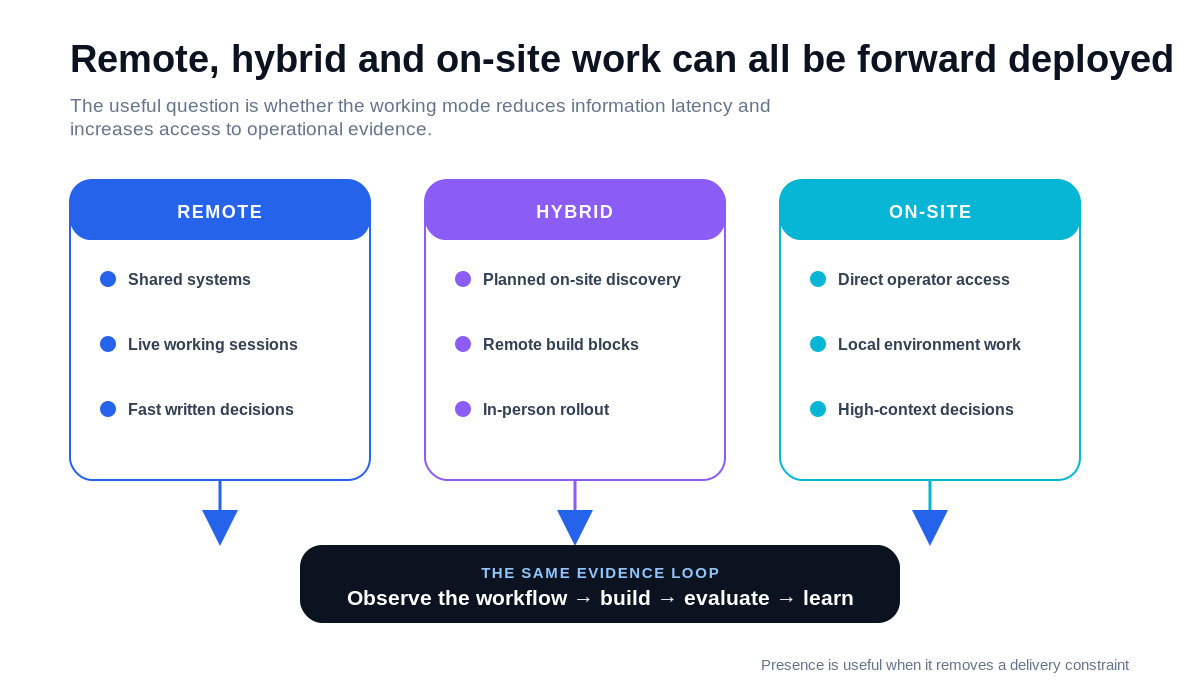
Travel is common in some FDE roles, but travel is a delivery mechanism. It is valuable when being present reduces information latency, unlocks an environment or improves a rollout decision.
Current public roles show variation. OpenAI’s healthcare FDE listing [1] states travel up to 50 percent. Palantir’s current FDSE listing [5] describes a hybrid role and travel requirements that can vary by assignment. Anthropic’s FDE listing [6] estimates 25 percent travel based on location. These figures belong to those listings, not to the role family as a whole.
| Mode | Best used for | Main failure mode |
|---|---|---|
| Remote | Focused build, written decisions, shared-system debugging | The FDE becomes a ticket receiver without operator context |
| Hybrid | On-site discovery followed by remote build and planned rollout | Important evidence falls between scheduled visits |
| On-site | Operator shadowing, local environment work, high-risk launches | Presence becomes ceremony rather than a way to remove a constraint |
What can a two-week FDE engagement look like?
The following calendar compresses an engagement into ten working days to show the cadence. It is not a promise that a production deployment should take two weeks. Regulated workflows, deep integrations and enterprise change can require much longer.
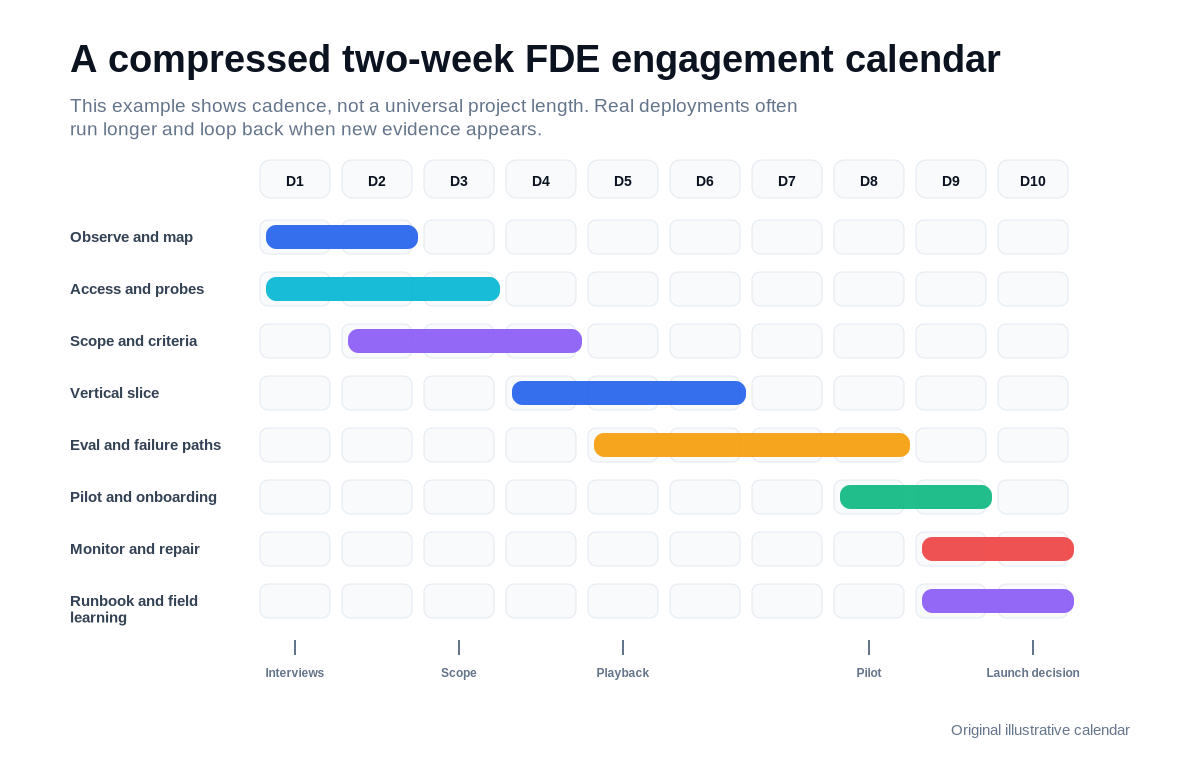
| Day | Main work | Exit evidence |
|---|---|---|
| 1 | Operator interviews, access request, representative cases | Initial workflow and access gaps |
| 2 | Workflow observation, API probe, exception inventory | Verified critical path |
| 3 | Scope, architecture choice, acceptance criteria | Agreed first-release boundary |
| 4 | Thin vertical slice across real interfaces | Feasibility evidence |
| 5 | Playback, backlog cut, eval cases | Prioritised build and quality bar |
| 6 | Integration and reliability controls | End-to-end workflow in test |
| 7 | Failure simulation and regression evaluation | Launch gaps and fixes |
| 8 | Pilot deployment and user onboarding | First-use evidence |
| 9 | Monitoring, defect repair, eval expansion | Updated launch recommendation |
| 10 | Continue, hold or roll back; runbook and field memo | Decision, ownership map and next phase |
The calendar contains feedback loops on purpose. New production failures should become test cases. Anthropic’s evaluation guide [14] separates capability evaluation from regression evaluation. The first asks what the system can do. The second protects behaviour that already works. An FDE needs both because progress is not useful if yesterday’s success disappears.
Who is likely to enjoy the FDE daily routine?
The role tends to suit engineers who like direct evidence, broad ownership and purposeful context switching. It may frustrate someone who wants every requirement settled before build or needs uninterrupted coding blocks as the default.
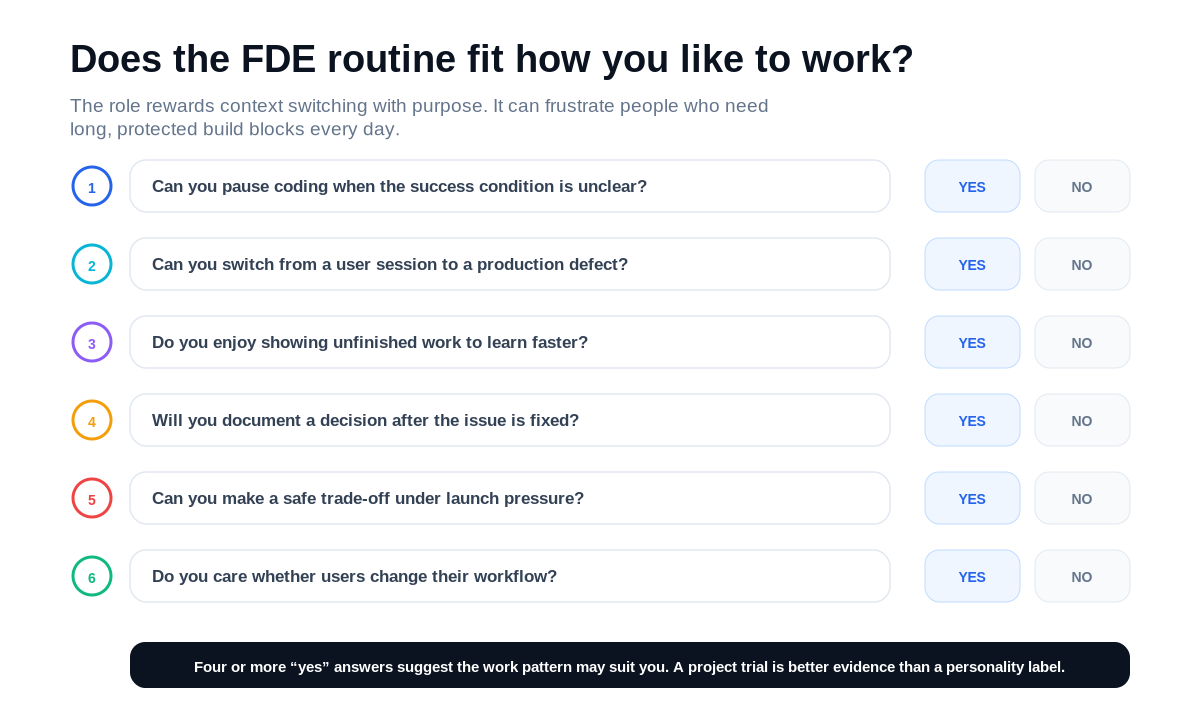
Six-question routine check
Four or more checks suggest good alignment with the routine. A project trial remains better evidence than a personality label.
Frequently asked questions about an FDE’s day-to-day work
What does a forward deployed engineer do every day?
An FDE removes the next risk blocking a customer deployment. Depending on the phase, that can mean workflow discovery, full-stack build, evaluation, rollout support, production debugging, adoption work or handoff documentation.
How much of an FDE’s day is spent coding?
There is no reliable universal percentage. Coding rises when integration is the main unknown and falls when workflow definition, access, evaluation or rollout is the current bottleneck.
Is a forward deployed engineer’s job meeting-heavy?
It can be during discovery or rollout, but the useful measure is whether each meeting produces a decision, evidence or an artifact. Meetings without a change in delivery state are coordination overhead.
What tasks does an FDE perform during technical discovery?
Typical tasks include operator shadowing, workflow mapping, data and API probes, risk identification, scope definition, acceptance criteria and a thin prototype that tests the riskiest assumption.
What does an FDE do during production rollout?
An FDE validates the release, watches production signals, triages defects, supports first users, protects rollback options and updates the runbook and evaluation set from real failures.
Do forward deployed engineers travel?
Travel varies by employer and account. Current role pages from OpenAI, Palantir and Anthropic show that travel can be part of the job, but customer-workflow proximity is more fundamental than physical presence.
Can a forward deployed engineer work remotely?
Yes, when the engineer still has direct access to users, systems and operational evidence. Remote work fails when it turns the role into ticket-taking or removes access to the real workflow.
What is the hardest part of an FDE’s routine?
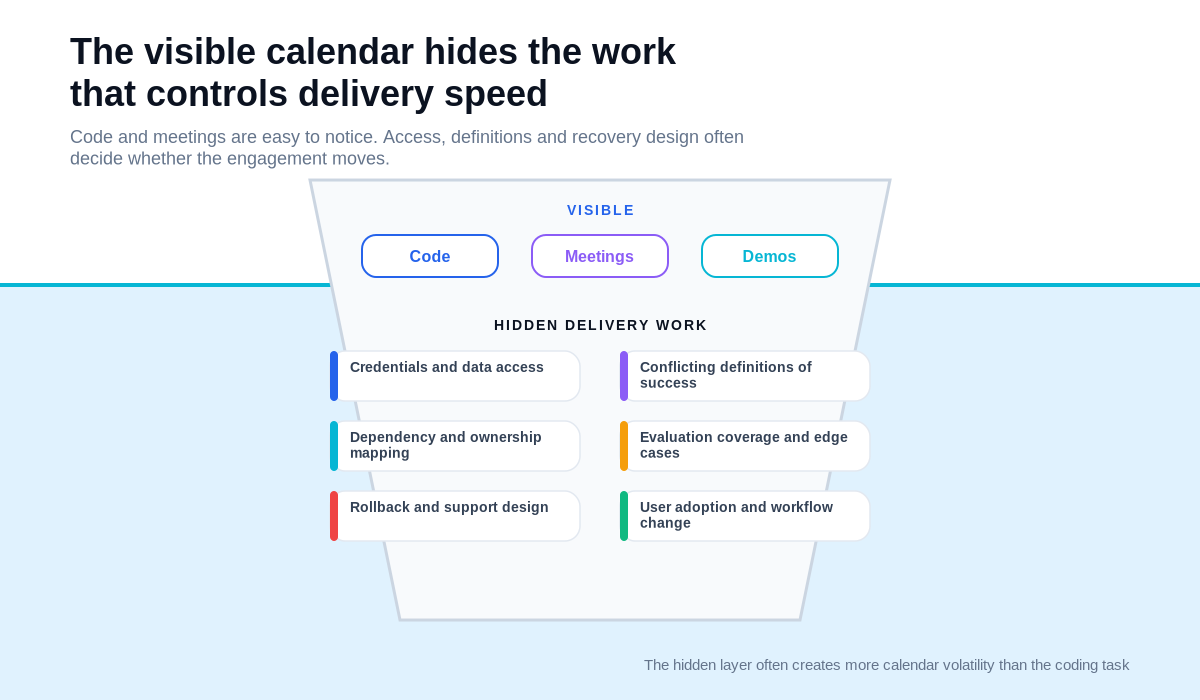
The hard part is usually switching between kinds of uncertainty without losing the delivery thread. Access delays, conflicting definitions of success and production incidents can reshape the day quickly.
How is an FDE schedule different from a software engineer’s schedule?
A product software engineer usually works from a product roadmap and a stable team context. An FDE schedule is more dependent on a specific customer workflow, external systems, rollout timing and live adoption evidence.
The simplest way to picture an FDE day
Start by asking what could still make the deployment fail. Spend the day reducing that uncertainty. Leave behind evidence another person can inspect or use.
A fixed routine would be easier to describe. It would also miss the defining feature of forward deployed work: the engineer stays with the problem as it changes from workflow ambiguity to technical risk, then to production behaviour and adoption.
MAP YOUR CURRENT SKILLS
See how your present role can map into FDE work
Review role-specific paths for backend, DevOps, data, QA, cloud, full-stack and consulting professionals.
Explore the FDE programmeSources and external engineering references
This guide was reviewed on 21 August 2026 against current public role descriptions and first-party engineering material. The time-allocation percentages and sample calendars are original explanatory models. They are not employer-reported averages.
- OpenAI, Forward Deployed Engineer (FDE), Healthcare - NYC. End-to-end ownership from discovery through handoff, production adoption, launch criteria, observability and travel expectations.
- OpenAI, Forward Deployed Engineer - UAE. Ownership of delivery state, sequencing, full-stack build, stable production and reusable field signal.
- OpenAI, Forward Deployed Software Engineer - SF. Experiment-driven full-stack delivery, customer embedding, scopes of work and project plans.
- OpenAI, Technical Deployment Lead, Forward Deployed Engineering - SF. Day-to-day execution, milestones, dependencies, sequencing, readiness, adoption and field feedback.
- Palantir, Forward Deployed Software Engineer. Direct customer work, rapid problem understanding, architecture and solution build.
- Anthropic, Forward Deployed Engineer. Production applications inside customer systems, deployment support, reusable patterns and estimated travel.
- OpenAI, Identifying and scaling AI use cases. Workflow mapping, use-case prioritisation and movement from isolated tasks to multi-step workflows.
- OpenAI API, Evaluation best practices. Evaluation objectives, representative datasets, metrics, comparison and continuous evaluation.
- OpenAI API, Evaluate agent workflows. Trace grading, workflow-level failure analysis, datasets and repeatable eval runs.
- OpenTelemetry, Observability primer. Traces, metrics and logs for understanding system behaviour and reliability.
- Google SRE, Monitoring Distributed Systems. Production monitoring, low-noise alerting and the four golden signals.
- AWS Builders’ Library, Timeouts, retries, and backoff with jitter. Failure handling for distributed dependencies, bounded retries and backoff.
- AWS Builders’ Library, Ensuring rollback safety during deployments. Rollback design and deployment safety when systems or data models change.
- Anthropic, Demystifying evals for AI agents. Deterministic graders, model-based graders, human review and regression evaluation.