
FDE ROLE AND CAREER
What Is a Forward Deployed Engineer? A Plain-English Guide to the Role
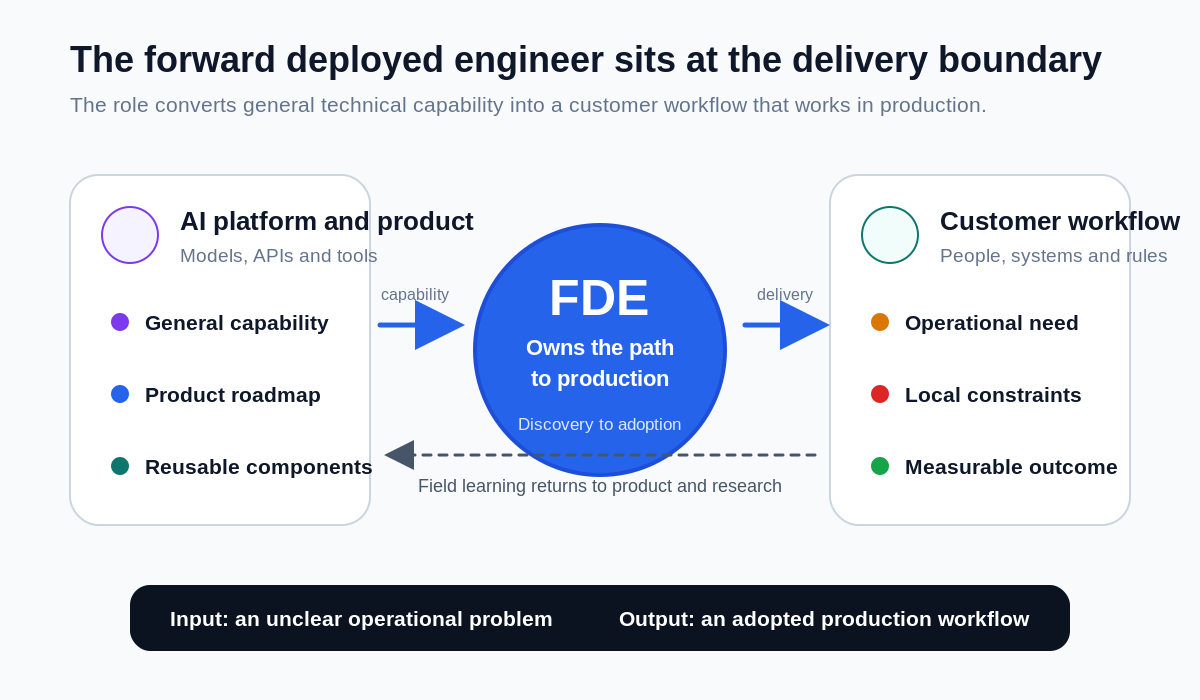
The clearest way to understand an FDE is to follow what the engineer owns: the path from a customer’s unclear operational problem to a stable system that people use.
Direct answer
A forward deployed engineer is a software engineer who works close to a customer’s real workflow and owns the technical path from an unclear problem to a stable production system. The work starts with discovery, continues through hands-on build and ends with rollout, adoption and field learning.
What is a forward deployed engineer?
An FDE is defined less by a fixed technology stack and more by an ownership boundary. The engineer enters an incomplete customer situation, finds the real workflow problem, designs the technical approach, writes production code and stays involved until the system can operate inside the customer environment.
OpenAI’s current FDE role description frames the engineer as an owner of discovery, technical scoping, system design, build and production rollout. It measures success through production adoption, measurable workflow impact and feedback that can change product or model roadmaps. [1] Palantir’s Forward Deployed Software Engineer description places the engineer side by side with customers and carries projects from ideation to deployment. [3]
Anthropic’s FDE description adds another useful part of the definition: FDEs work within customer systems, ship production applications and codify patterns that can be reused by product and engineering teams. [4] Scale AI’s GenAI FDE description also combines daily technical customer work with full-stack delivery and product influence. [5]
The common denominator across current FDE roles
The FDE is close enough to understand the workflow, technical enough to build the system and accountable long enough to see whether it works in production.
| Employer | Public role emphasis | What this reveals |
|---|---|---|
| OpenAI | End-to-end deployments from discovery through production rollout | Ownership continues beyond a prototype |
| Palantir | Direct customer work, architecture and custom applications | Customer context and engineering depth sit together |
| Anthropic | Production applications inside customer systems plus repeatable deployment patterns | Field work should produce reusable learning |
| Scale AI | Daily technical collaboration, full-stack delivery and product influence | The role crosses product and customer boundaries |
Role titles are not standardised. The table identifies the shared operating model, not a universal job specification.
Why does the FDE role exist?
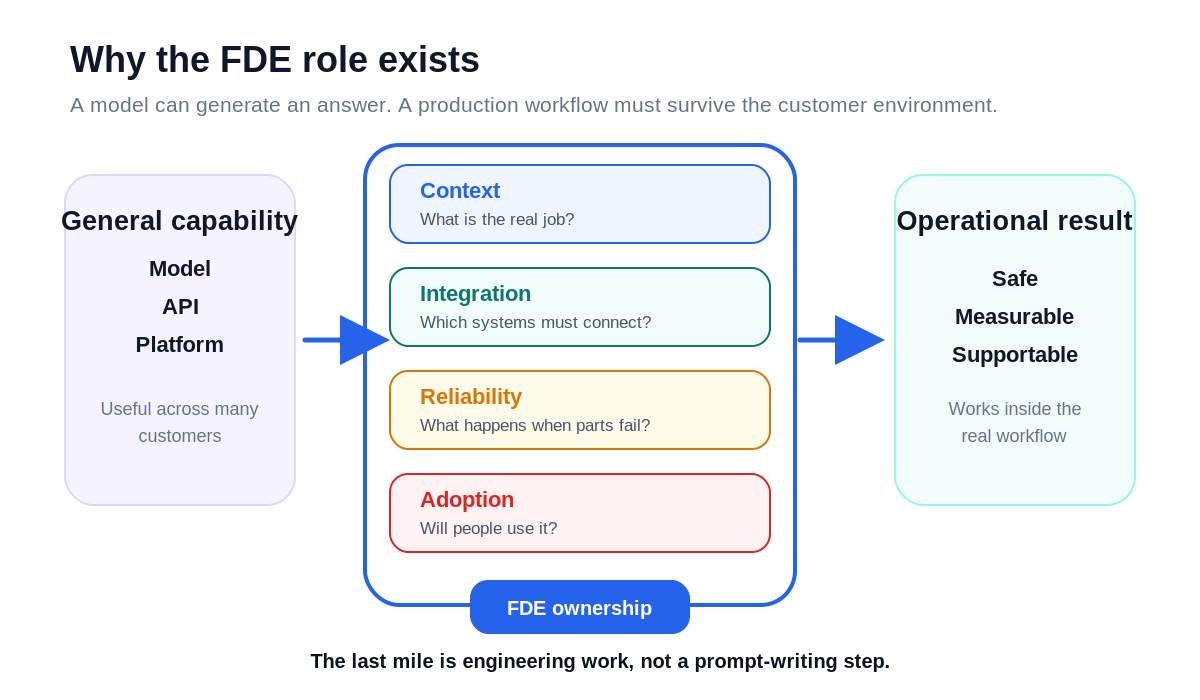
Start from first principles. A software platform must be general enough to serve many customers. A real customer workflow is specific. It contains local data, existing systems, approval rules, security limits and human habits. A model or API cannot know all of that in advance. OpenAI’s use-case guidance similarly starts from concrete work patterns and measurable impact. [6]
This creates a delivery gap. Someone must translate an operational need into technical requirements, decide what should remain deterministic, connect the system to real tools, define failure behaviour and guide adoption. OpenAI’s agent-building guide recommends checking whether deterministic automation is sufficient before using an agent and adding human intervention for high-risk actions. [7] That work requires engineering authority because the answer often changes the architecture or the code.
The FDE closes this gap without assuming that every customer needs a permanent one-off codebase. Strong forward deployed work also identifies which parts can become a connector, evaluation library, deployment template or product feature. OpenAI and Anthropic both include codifying repeatable patterns and returning field insight to internal teams in current role descriptions. [1] [4]
What does “forward deployed” mean?
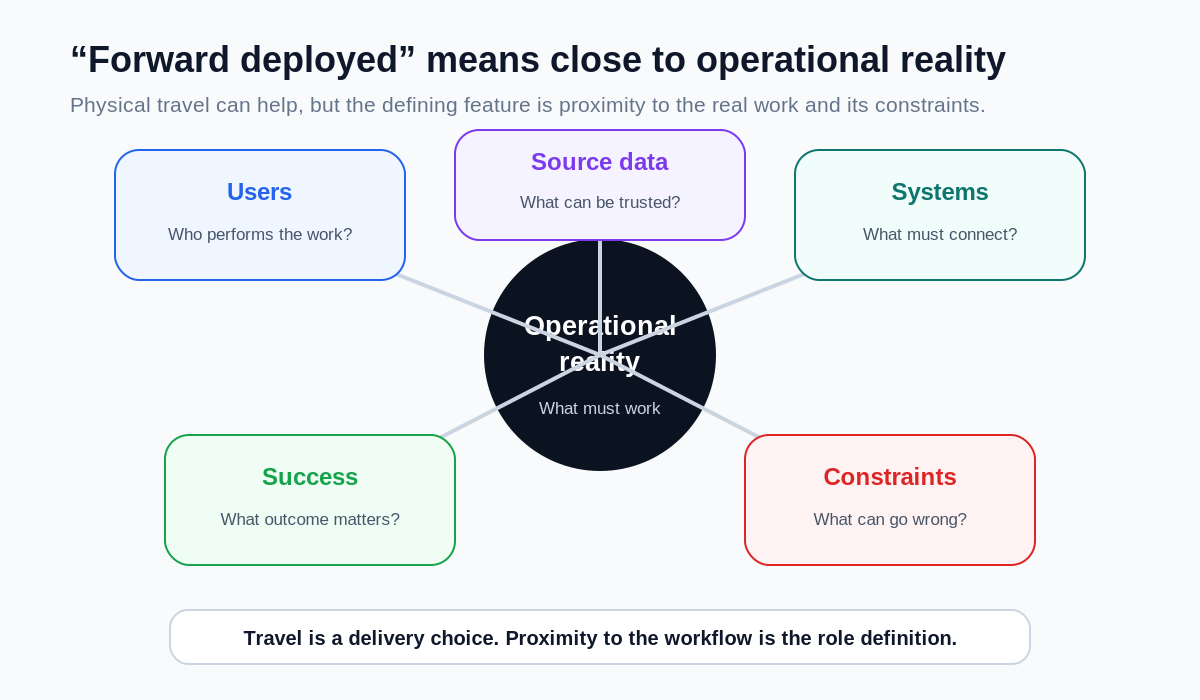
“Forward deployed” means the engineer works close to the place where the software must create value. That proximity has five forms: direct contact with users, access to the real data, knowledge of existing systems, awareness of constraints and agreement on success measures.
It does not mean every FDE must sit permanently at a customer office. Current roles include hybrid arrangements and different travel expectations. OpenAI’s NYC listing describes hybrid work with travel up to 50 percent. Palantir’s New York listing is hybrid and describes travel up to 25 percent. Anthropic’s US listing estimates travel at 25 percent.[1][3][4] The practical inference is that physical presence is one way to gain context, while workflow proximity is the durable feature of the role.
What does a forward deployed engineer own?
An FDE usually owns the technical thread across an engagement. The exact handoffs differ by employer, but the public role descriptions point to a consistent arc. For model-powered systems, OpenAI’s evaluation best practices provide a practical loop: define the objective, collect a representative dataset, choose metrics, compare versions and evaluate continuously. [8]
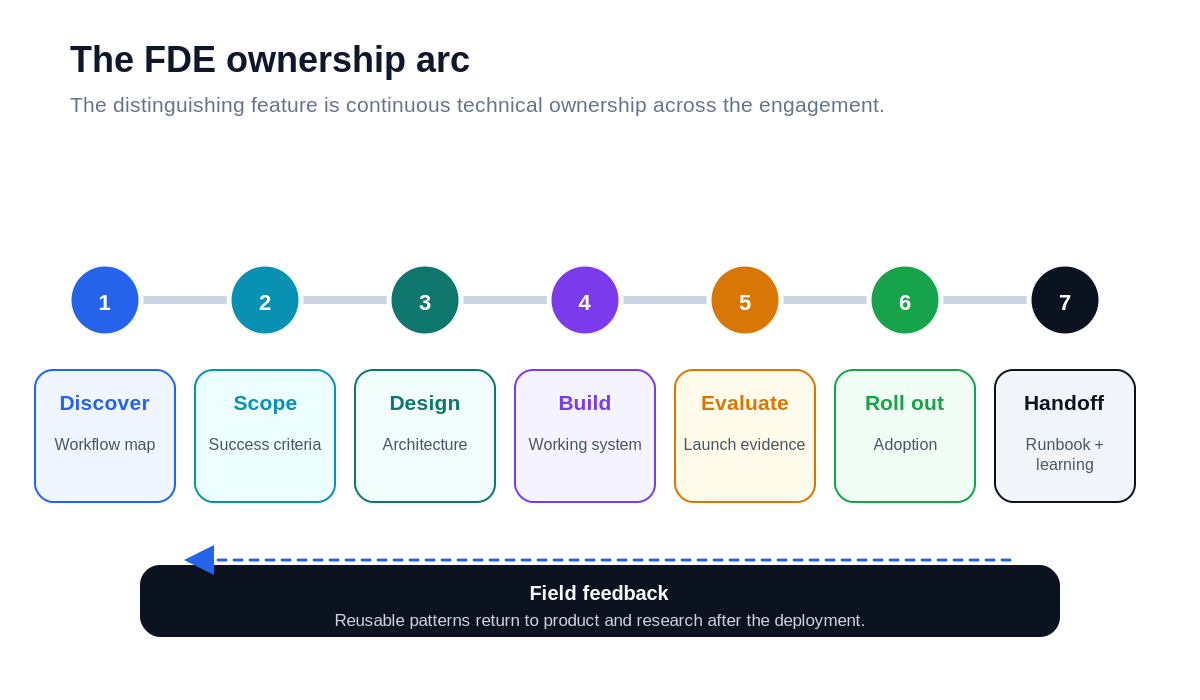
| Stage | Question the FDE answers | Typical evidence |
|---|---|---|
| Discovery | What job is the customer trying to complete? | Workflow map and stakeholder notes |
| Scope | What will the first deployment do and not do? | Acceptance criteria and risk boundary |
| System design | Which data, services and controls are required? | Architecture and decision record |
| Build | Can the system perform the workflow end to end? | Production-grade code and integrations |
| Evaluation | What evidence is strong enough to launch? | Test set, thresholds and failure analysis |
| Rollout | Can users adopt the system without unsafe workarounds? | Pilot plan, monitoring and adoption signals |
| Handoff | Can the system be supported and improved after launch? | Runbook, ownership map and reusable pattern |
What is outside the FDE’s ownership?
The FDE role is broad, but it is not unlimited. A current OpenAI healthcare listing states that the FDE owns the technical solution while ownership of the commercial or executive relationship is not required. [2] The customer still owns business policy. Core research teams still own frontier model research. Long-term operations may transfer to a customer team or an internal support owner after handoff.
The better boundary is: the FDE is accountable for making the technical solution real and supportable, without pretending to own every business decision around it.
What does FDE work look like in a real engagement?
An online retailer has an AI support agent. The agent reads a complaint, checks the order, decides whether a refund is allowed and updates the CRM. During a pilot, the order API sometimes times out. The agent keeps retrying. In some cases, the refund action is submitted twice.
A weak response changes the prompt or adds another retry. An FDE treats this as a state and workflow safety problem. The broader threat model should also cover tool misuse, excessive agency and prompt injection. NIST’s Generative AI Profile provides a lifecycle risk framework, while OWASP’s 2026 Agentic Applications Top 10 provides a security checklist for agents that act across tools. [13] [14]
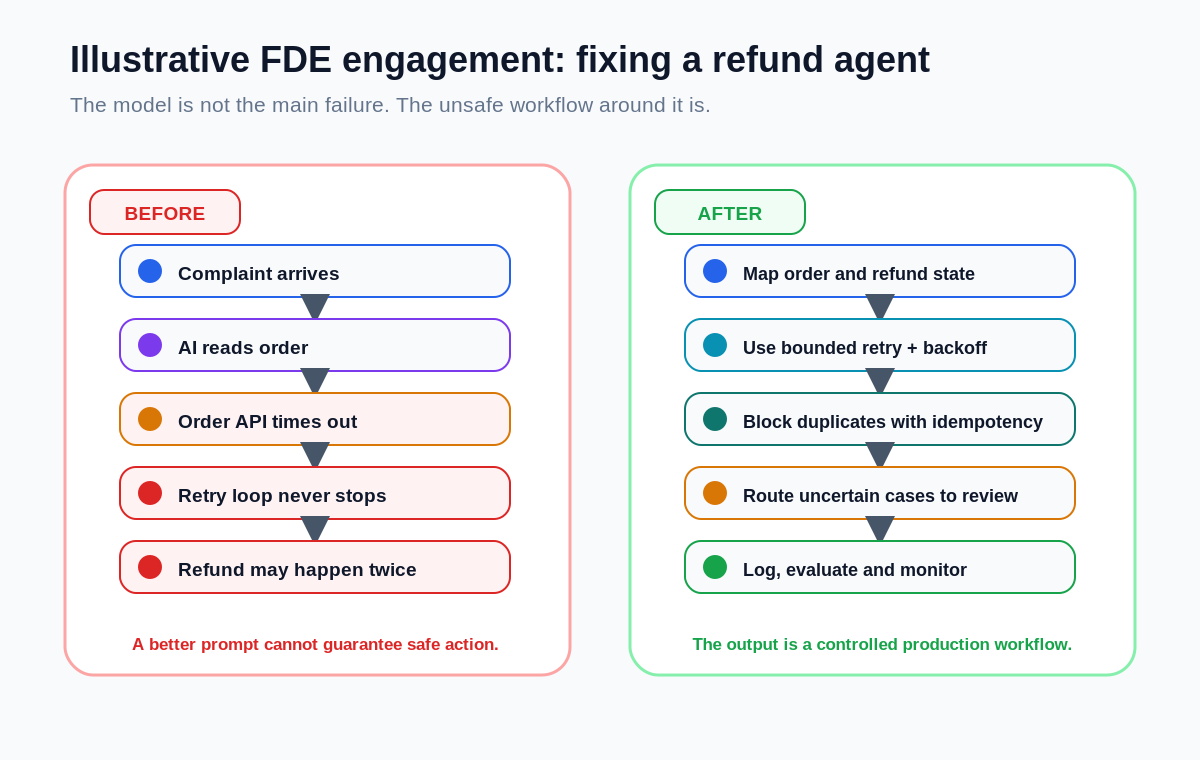
- Define the production outcome. A valid refund should be completed once, linked to the correct order and recorded in the CRM.
- Map system state. The design tracks ticket ID, order ID, attempt count, approval state, refund status and the final CRM update.
- Make retries safe. The system uses bounded retries and backoff [9], plus an idempotency key [10] so the same refund cannot be created twice.
- Protect uncertain decisions. Cases with missing data, policy conflict or low confidence move to human review before an irreversible action. [7]
- Evaluate failure paths. The test set follows task-specific evaluation principles and deliberately simulates timeouts, duplicate events, stale order data and partial CRM failure. [8]
- Roll out with visibility. Logs, traces and metrics show each state transition. [12] The alerting plan follows production monitoring principles, while the pilot measures resolution time, duplicate-action rate and human-review rate. [11]
- Return reusable learning. The idempotent action pattern and failure evaluation become building blocks for other agent workflows. [10] [8]
The FDE decision in this example
The model may already understand the complaint. The production risk comes from retries, state, permissions and irreversible actions. The FDE changes the system around the model so that a useful answer becomes a safe business action.
How is a forward deployed engineer measured?
Current OpenAI role descriptions give the clearest public answer: production adoption, measurable workflow impact and evaluation-driven feedback that changes product or model roadmaps. [1] The healthcare role also refers to customer-specific benchmarks, acceptance criteria and launch readiness. [2]
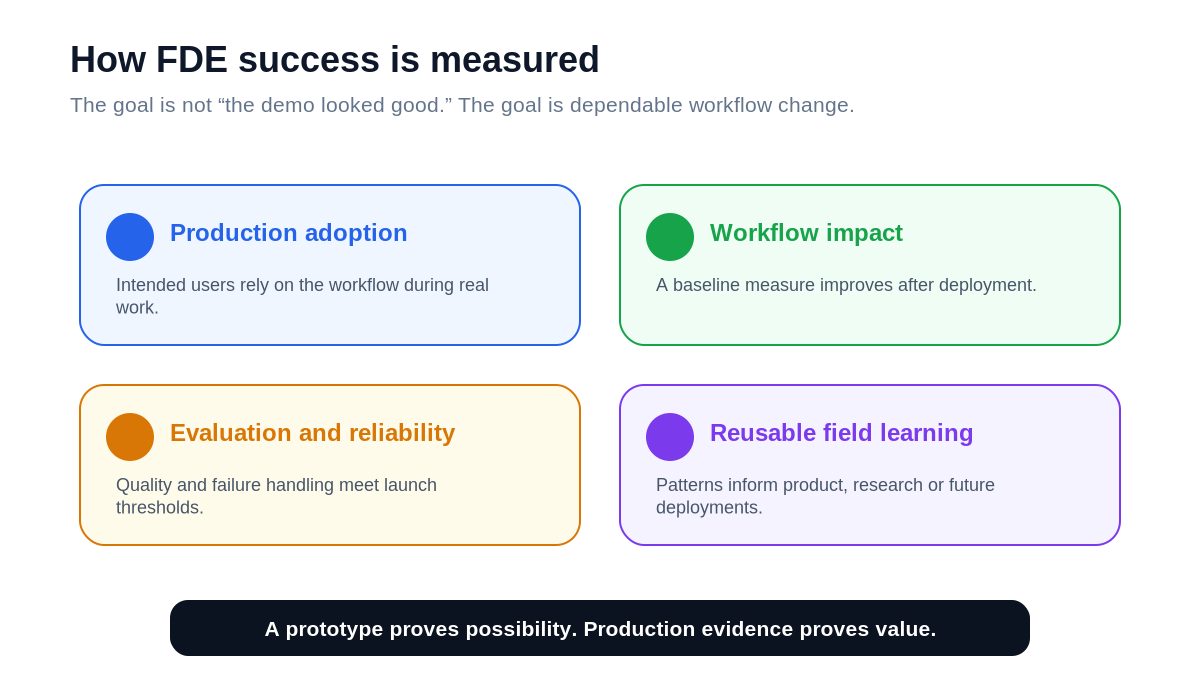
| Measure | Example question | Possible signal |
|---|---|---|
| Adoption | Do intended users rely on the workflow? | Weekly intended-user usage |
| Workflow impact | Did the target process improve? | Time per completed case |
| Quality | Does output meet the launch threshold? | Task success on a held-out set |
| Reliability | Does the system recover from expected failure? | Successful completion after dependency errors |
| Safety | Are high-risk actions controlled? | Unauthorised action rate |
| Repeatability | Can the pattern help another deployment? | Reusable connector or evaluation component |
OpenAI’s enterprise use-case guidance also emphasises workflow mapping and prioritising use cases by impact and effort. [6] This matters because an FDE should be willing to narrow, postpone or reject a use case when the expected value does not justify its risk or delivery cost.
How is an FDE different from a software engineer, solutions engineer or consultant?
The boundaries overlap. Company titles can hide large differences, so compare roles by the work they own rather than by the label alone.
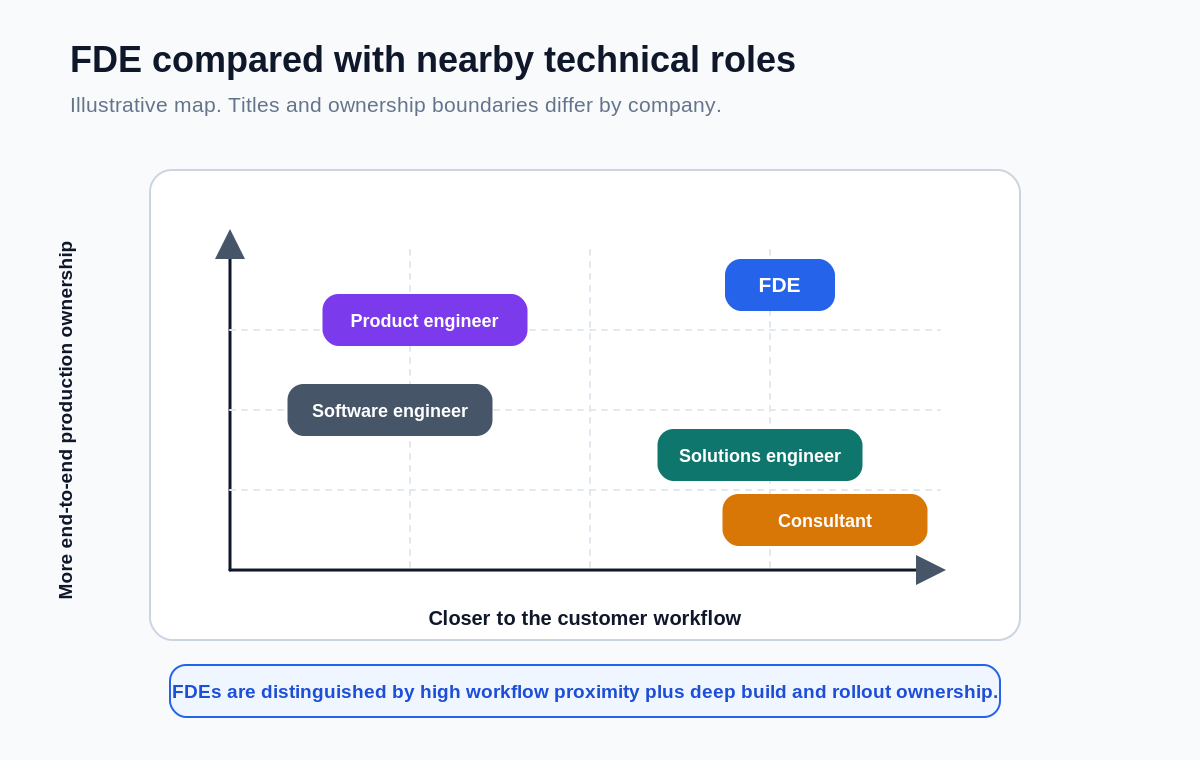
| Role | Main centre of gravity | Typical output | Where FDE differs |
|---|---|---|---|
| Software engineer | Product or platform code | Features and services | FDE owns more customer discovery and rollout context |
| Product engineer | Fast product iteration | User-facing product improvements | FDE works inside a specific customer environment |
| Solutions engineer | Technical fit and solution proof | Architecture, demo or proof of concept | FDE usually continues further into build and production |
| Technical consultant | Diagnosis and recommendation | Plan, design or implementation support | FDE normally carries stronger direct code ownership |
| Forward deployed engineer | Customer workflow outcome | Adopted production system plus reusable field learning | Combines discovery, engineering and delivery |
Who is likely to enjoy forward deployed engineering?
The role tends to suit engineers who like ambiguity, direct user feedback and broad technical ownership. It can be uncomfortable for someone who needs stable requirements, limited context switching or very little customer contact.
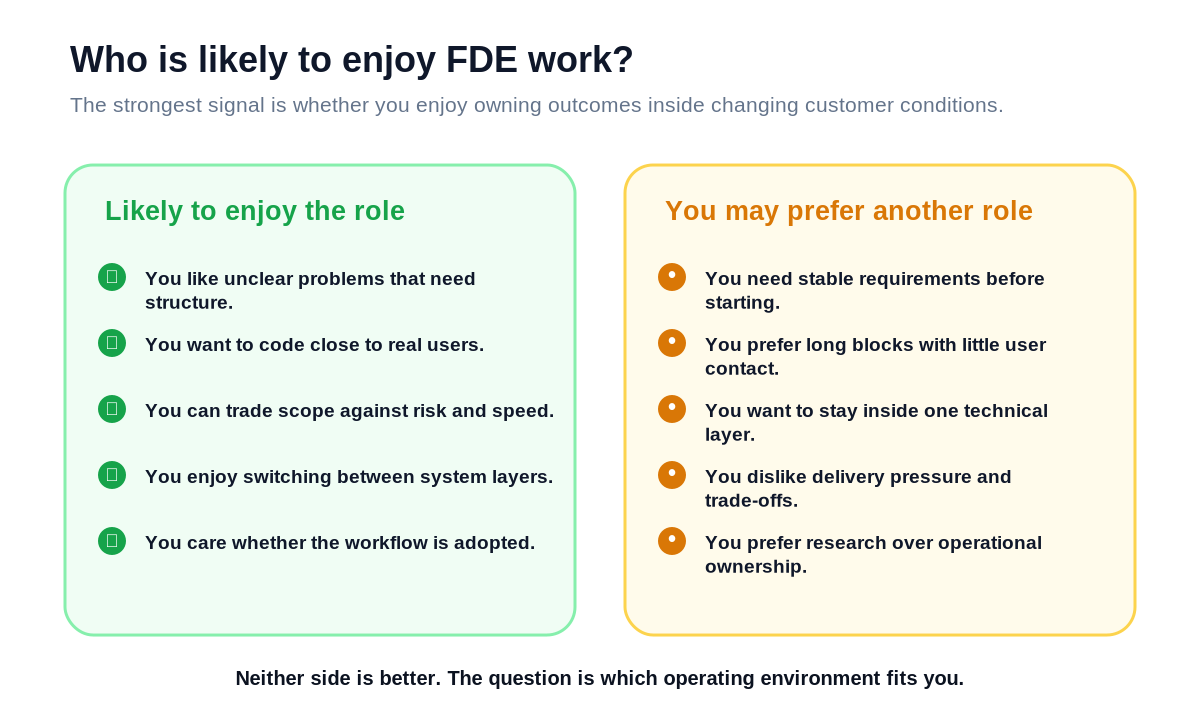
Five-question FDE self-check
Four or five checks suggest strong alignment. Two or three suggest that a project-based trial would be useful before a career move.
Is forward deployed engineering mainly a travel job?
No. Travel can be substantial in some positions, but it is a means of gaining context and accelerating delivery. The job is defined by customer-workflow proximity and technical ownership. A hybrid FDE can still be deeply embedded through shared systems, live working sessions and direct access to operators. A frequently travelling engineer can still fail at FDE work if the engagement never moves beyond meetings and demos.
What should someone learn before pursuing an FDE role?
Start with a production service you can build and debug. Add a model-powered workflow with evaluation. [8] Then learn enterprise integration, agent security, observability, retries and failure handling and customer discovery. [14] [12] [9] The evidence matters more than a long tool list.
BuildAI Careers organises its FDE curriculum around the same delivery path: understand the requirement, design the solution, integrate systems, deploy safely and support the production environment. The full skills roadmap belongs in a separate guide, but the first proof should be an end-to-end workflow with clear acceptance criteria.
Frequently asked questions about forward deployed engineers
What is a forward deployed engineer in one sentence?
A forward deployed engineer is a software engineer who works close to a customer workflow and owns the technical path from an unclear problem to a stable production system.
Does a forward deployed engineer write code?
Yes. Current FDE descriptions from OpenAI, Anthropic, Palantir and Scale AI all include hands-on engineering, production applications or full-stack delivery.
Is a forward deployed engineer a sales role?
No. The role is customer-facing and may work with sales or go-to-market teams, but its core output is a technical deployment. Some employers separate commercial relationship ownership from FDE technical ownership.
Is an FDE the same as a solutions engineer?
No universal boundary exists. A solutions engineer often helps prove fit before purchase. An FDE usually holds deeper build, rollout and adoption ownership after the problem is selected.
Do forward deployed engineers have to travel?
Travel is common but varies by employer and location. The defining feature is proximity to the customer workflow, which can include hybrid work, remote collaboration and time on site.
What is the difference between FDE and FDSE?
FDE means Forward Deployed Engineer. FDSE means Forward Deployed Software Engineer. The titles usually describe the same role family, although each employer sets its own scope.
Can a software engineer become a forward deployed engineer?
Yes. The main additions are customer discovery, system integration, delivery planning, evaluation, production operations and clear communication with technical and business stakeholders.
Are all FDE jobs focused on AI?
No. The role predates the current generative AI cycle. Many current openings at AI companies focus on model-powered applications, evaluation, enterprise integration and production reliability.
What is the main deliverable of an FDE?
The main deliverable is a production workflow that people can use safely and measure. Reusable deployment learning is a second output because it can improve the platform or future engagements.
The simplest test for understanding the FDE role
If the job ends when the demo works, the ownership boundary is too early. Forward deployed engineering continues until the workflow is safe, measurable, adopted and supportable.
Sources and external engineering references
This guide was reviewed on 20 August 2026 against current public role descriptions and first-party engineering material. Employer links define the role. Engineering links support the architecture, evaluation, reliability, observability and risk guidance. Job descriptions can change, so role-specific requirements should be checked at the employer source.
- OpenAI, Forward Deployed Engineer (FDE), NYC. Current role definition, end-to-end ownership, production adoption, workflow impact and field feedback.
- OpenAI, Forward Deployed Engineer (FDE), Healthcare, NYC. Technical ownership from discovery through handoff, regulated workflow context and the boundary from commercial relationship ownership.
- Palantir, Forward Deployed Software Engineer. Palantir’s description of the FDSE model, direct customer work, custom applications and ideation-to-deployment ownership.
- Anthropic, Forward Deployed Engineer. Work inside customer systems, production AI applications, deployment support and codifying repeatable patterns.
- Scale AI, Forward Deployed Engineer, GenAI. Daily technical customer collaboration, full-stack delivery, distributed systems and product influence.
- OpenAI, Identifying and scaling AI use cases. Workflow mapping, adoption, impact-oriented use-case selection and impact-versus-effort prioritisation.
- OpenAI, A practical guide to building agents. Agent suitability, deterministic alternatives, tool design, guardrails, retry limits and human intervention for high-risk actions.
- OpenAI, Evaluation best practices. Task-specific evaluation design, representative datasets, metrics, continuous evaluation and production failure cases.
- AWS Builders’ Library, Timeouts, retries, and backoff with jitter. Bounded retries, timeouts, backoff, jitter and avoiding retry-driven overload in distributed systems.
- AWS Builders’ Library, Making retries safe with idempotent APIs. Idempotent operation design and safe handling of repeated requests without duplicate side effects.
- Google SRE, Monitoring Distributed Systems. Production monitoring, alerting and the four golden signals: latency, traffic, errors and saturation.
- OpenTelemetry, Observability primer. Instrumentation and the use of traces, metrics and logs to understand system behaviour and reliability.
- NIST, Generative AI Profile for the AI Risk Management Framework. Lifecycle risk management for trustworthy generative AI design, development, use and evaluation.
- OWASP, Top 10 for Agentic Applications 2026. Security risks and mitigations for autonomous and agentic systems that plan, use tools and take actions.